
Every software category that depends on human interaction eventually reaches the same crossroads. It happens in hiring platforms, assessment tools, onboarding systems, learning environments, telehealth applications, and every product that relies on live communication.
At some point, a team looks at its roadmap and asks the uncomfortable question - should we build our own video infrastructure or buy one by integrating a programmable platform through a video conferencing API designed for it.
This question is never about technology alone - it touches budgets, hiring plans, product velocity, compliance, user retention, and the long term shape of the company.
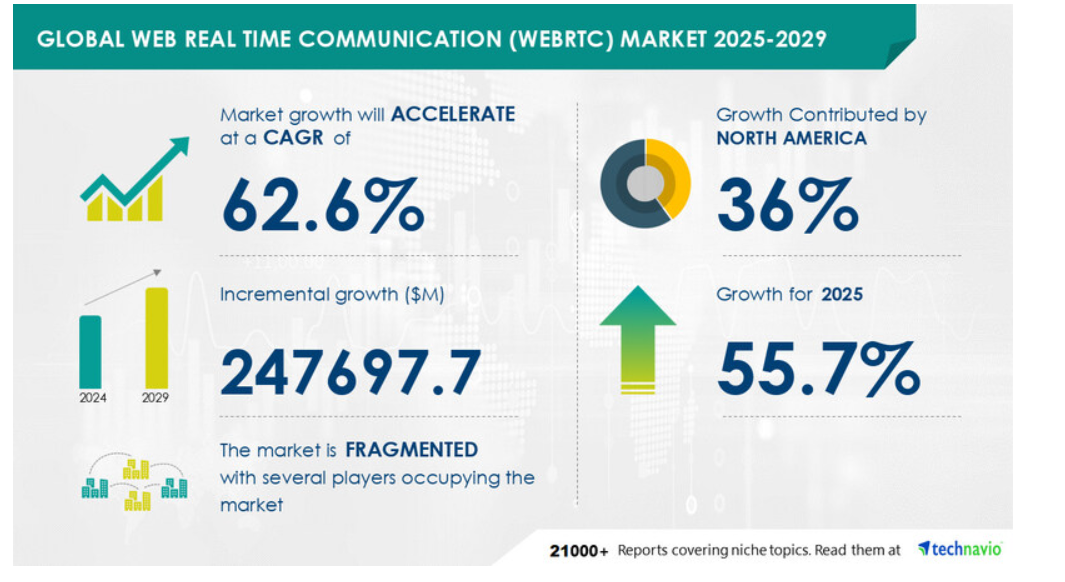
Growth in Webrtc Market (Source)
And in 2026, the answer has shifted more than most teams realise.
The expectations around live video have risen faster than the technical capabilities inside most product teams. What used to be acceptable - a simple WebRTC connection stitched together with a signalling server is no longer enough.
Modern users expect reliability, fast join times, sharp video even on weak networks, crisp audio, intelligent recordings, and the kind of stability they subconsciously associate with tools like Meet and Zoom. Anything short of that becomes a friction point in the core workflow.
Against that backdrop, the build vs buy video infrastructure conversation becomes less of an engineering debate and more of an operational truth.
Either the product chooses to own a full scale media infrastructure team, or it chooses to integrate a system that already solves these problems. There is very little room in between.
Why The Decision Has Become Harder And Not Easier
Two years ago, many companies believed the build route would give them control, differentiation, and long term cost savings. And that belief made sense when the requirement was limited to basic one to one calls with occasional screen sharing.
But video infrastructure today carries far more weight in SaaS products.
A hiring platform depends on it to reduce candidate drop offs, a remote assessment product depends on it to ensure consistent proctoring, an onboarding tool depends on it to deliver smooth live sessions for employees joining from different countries, a telehealth application depends on it to maintain trust between clinician and patient, regardless of network constraints.
When video becomes the moment of truth inside a workflow, the tolerance for issues collapses. A delay that once seemed trivial quickly becomes a business risk. Something as small as a 400 millisecond lag can lead to interview frustration. A video freeze at the beginning of a doctor patient session can destroy trust and a failed recording in an onboarding session can force teams to repeat their training schedules.
This is the reality most teams encounter only after shipping their first version as the engineering challenges do not arrive all at once. They accumulate quietly, release after release until the team realises it is maintaining a parallel product that demands continuous attention.

What Engineering Teams Rarely Account For
WebRTC is often misunderstood as a plug and play protocol. It works beautifully when the variables are controlled - fast networks, updated browsers, powerful devices.
But real users live in a different world.
They join calls from old laptops, shared Wi-Fi, office firewalls, rural networks, overloaded CPUs, enterprise environments, and mobile browsers. Building an experience that works for all of them is not just a technical puzzle, it's an ongoing responsibility.
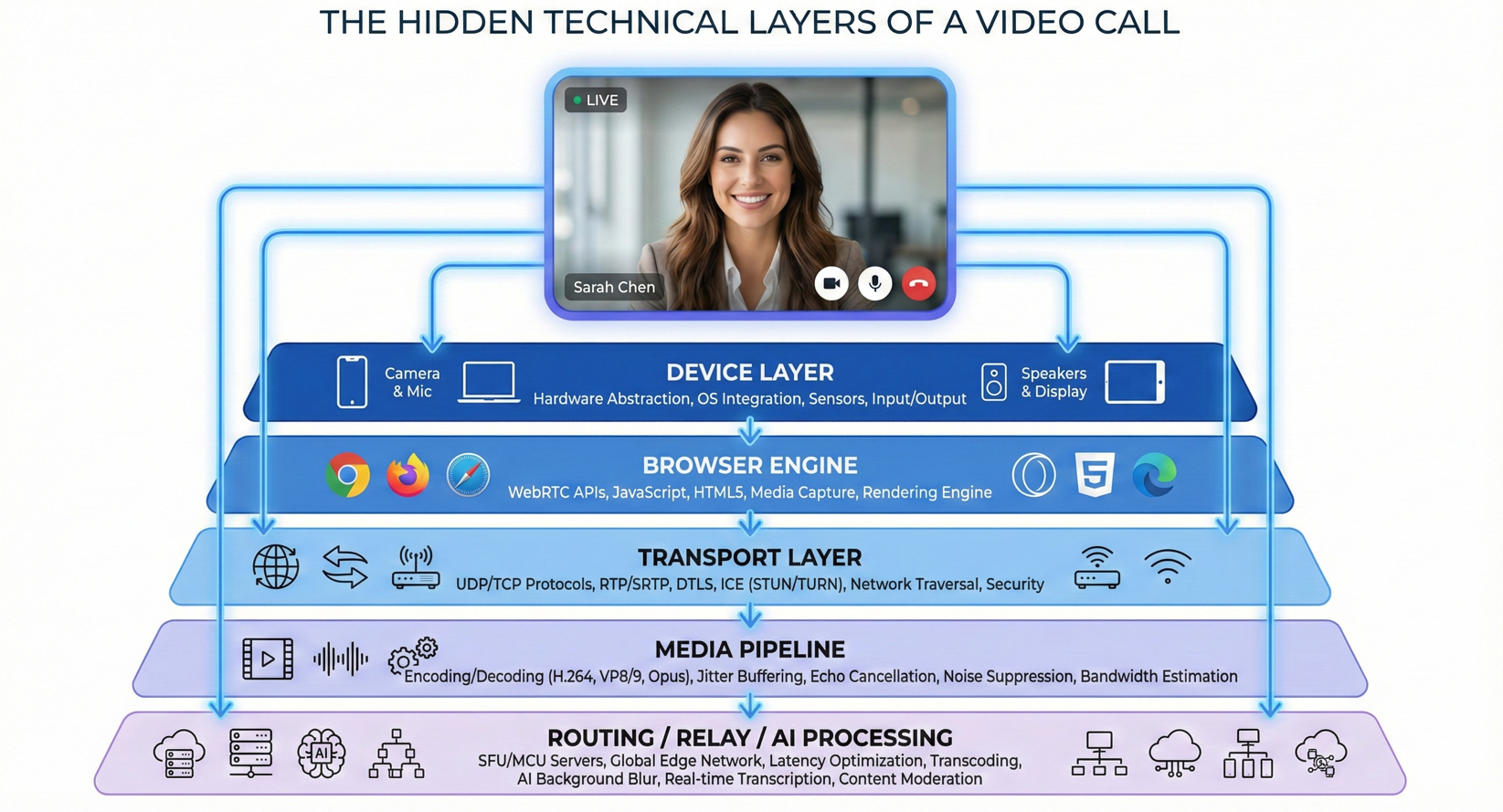
Hidden Technical Layers of a Video Call
A functional media stack needs far more than STUN, TURN, and signalling.
It needs an SFU architecture that can forward streams intelligently, bandwidth adaptation that adjusts video layers based on real time conditions, echo cancellation, jitter buffering, error correction, congestion control, and predictable fall-back when network paths fail. And every one of these components must be tested across regions and device types.
Then there is the debugging challenge.
A customer reports that calls are dropping for a subset of users in a specific city. On the surface, it sounds like a network issue but the underlying cause could be a codec mismatch, a routing behaviour in the local ISP, a CPU throttling pattern on older machines, or a browser regression introduced only in the latest release. Engineering teams without deep media experience often spend weeks chasing the wrong variables.
At some point, the team recognises that they did not just build a feature but built an infrastructure dependency. And infrastructure, by definition, never stops evolving.
The True Cost Of Building Internally
The first instinct when evaluating cost is to look at how many engineers are needed to build an MVP. But, MVPs do not represent operational reality as the real cost shows itself only when teams attempt to maintain the system at scale.
A typical internal build for a production ready video layer requires a team that looks something like this -
- A media engineer who understands codecs and transport behaviour
- A back end engineer who maintains signalling and infrastructure
- A front end engineer who owns in call UI
- A DevOps engineer who manages real time traffic
- A QA specialist who tests edge cases across devices
- An architect or manager who keeps the system stable as the product grows
That is the baseline and not the specialised version - the absolute baseline needed for reliability.
Even with a lean team, the annual cost quickly moves past $800k when salaries, infrastructure, and operational overheads are factored in.
TURN servers alone can become expensive when a large percentage of calls route through relays. Storage for recordings, egress costs, transcoding workloads, and monitoring systems create their own recurring burden.
Beyond the financial cost is the opportunity cost.
Every hour spent tuning media pipelines is an hour not spent improving candidate workflows, assessment logic, scheduling systems, compliance dashboards, or the product capabilities that actually differentiate the company.
This is where internal builds begin to feel heavy. The team cannot move quickly because too much energy is spent protecting a layer that customers assume will work seamlessly.
The Cost Structure When Buying
The economics are different when teams adopt a programmable video conferencing API.
The cost scales with usage and not with engineering complexity. Further, there is no need to hire a dedicated media team or to maintain SFU clusters or global routing logic. There is no ongoing scramble to adjust to browser behaviour changes.
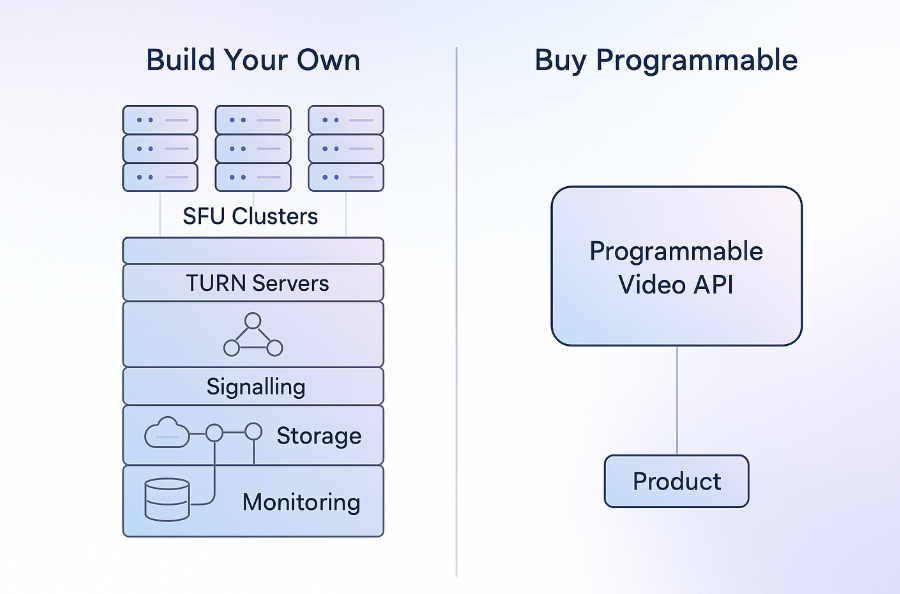
Cost Comparison Architecture (Build vs Buy Infrastructure Stack)
Most SaaS companies in HRTech, EdTech, and Telehealth operate within predictable usage ranges. Their video minutes grow gradually alongside product adoption.
For these companies, usage based pricing typically falls in the $18k to $60k annual range, depending on how interactive their sessions are and whether recordings or advanced processing are required.
The gap between both models becomes too large to ignore.
Internal builds require close to a million dollars a year to maintain predictable reliability while fully managed platforms cost a fraction of that and shift the operational responsibility to a dedicated infrastructure provider.
This is why more companies have started to realise that buying is not a shortcut but a way to protect their core roadmap and stay focused on features that move metrics.
Hidden Risks That Surface Only At Scale
When teams evaluate build versus buy, they often compare the cost of the API with the cost of initial development. The comparison rarely includes the friction that shows up in later stages.
The first hidden risk is customer expectation. Users benchmark every in app video call against the global tools they use daily. They expect fast connection times, smooth video across unpredictable networks, and recordings that never fail. Even a slight deviation from that baseline becomes visible immediately.
The second risk is compliance.
HRTech and Telehealth teams start encountering procurement requirements around data routing, encryption standards, audit logs, and region specific storage rules. Internal builds that seemed sufficient during prototyping often fall short when enterprise clients request detailed technical and compliance documentation.
The third risk is stability.
Every browser update introduces new behaviour that may break parts of the video pipeline. Maintaining cross browser consistency is one of the most demanding responsibilities for any in house team.
The final risk is that video has become increasingly AI driven. Noise suppression, speaker detection, enhanced recordings, and transcriptions have moved from “nice to have” to “expected by default.” Each of these capabilities requires deep domain expertise and additional infrastructure layers.
These are the areas where internal builds experience stress. The features that once felt manageable begin to expand beyond the team’s comfort zone.
What Benchmarks Really Matter In 2026
Evaluating video infrastructure requires a clear set of performance markers - not the theoretical ones.
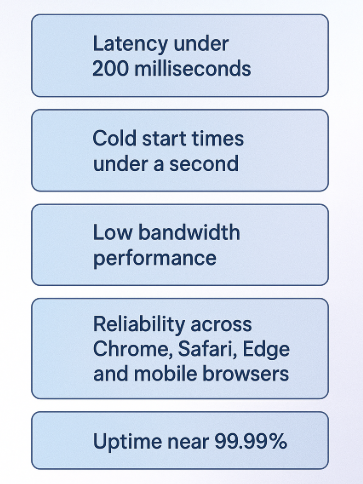
Benchmarks for Video Infrastructure
Here are a few of them -
- Latency under 200 milliseconds is critical for conversational clarity.
- Cold start times under a second influence how confident users feel when joining a session.
- Low bandwidth performance determines whether remote candidates, students, or patients can participate smoothly - a well optimised system should remain stable even at 300kbps to 500 kbps kbps total bandwidth
- Reliability across Chrome, Safari, Edge, and mobile browsers determines whether support teams get flooded with tickets.
- Uptime near 99.99% is the minimum threshold for enterprise adoption.
When an internal system struggles to meet these numbers consistently, it becomes a bottleneck and when an API meets them out of the box, it becomes an enabler.
A More Grounded Way To Make The Decision
The real question companies need to ask is not whether they can build the infrastructure - most teams with strong engineers can build the first version. The deeper question is whether they want to make this a permanent part of their organisation’s scope.
Building video infrastructure means accepting long term ownership of a rapidly evolving system. It means investing in media expertise, monitoring systems, and global routing. It means building a parallel product beneath the main product.
Buying, on the other hand, means focusing on the layers that create differentiation - the candidate experience, the assessment workflows, the interview logic, the classroom tools, the telehealth flow, the onboarding environment. These are the layers that strengthen your position in the market.
This is why more companies are moving towards programmable APIs.
They want control over branding and UI without inheriting the cost of building media infrastructure from scratch, they want low latency across global regions without managing clusters and, they want enterprise grade reliability without dedicating half their engineering team to maintaining it. Many reach this conclusion during their internal build vs buy video infrastructure evaluation.

The Conclusion Most Teams Reach
By the time a product hits significant traction, the build versus buy question becomes clearer. Companies that build eventually realise they are maintaining a system that grows in complexity faster than their ability to support it and companies that buy find themselves moving faster in roadmap execution and delivering a better experience without stretching their team.
In 2026, the case for buying has become stronger not because APIs have become cheaper but because expectations around video infrastructure have grown far beyond what most teams can support internally.
If video is not your core product, then building it internally becomes a tax on your roadmap. If video is central to your workflow and not your source of differentiation, then buying gives you the clarity, predictability, and engineering freedom that most growing products need. And for most SaaS teams, this is exactly where the build vs buy video infrastructure decision settles.
Frequently Asked Questions
1. What does “build vs buy video infrastructure” actually mean?
The build vs buy decision compares whether a company should create its own video infrastructure using internal engineering resources or integrate a programmable video conferencing API. Building offers deep control but requires significant time, cost, and media engineering expertise. Buying provides faster deployment, predictable performance, and lower long-term maintenance overhead.
2. When does it make sense to build video infrastructure internally?
Building is practical only when video is the company’s core product and there is a team with specialists in WebRTC, SFU routing, transport behavior, and global media performance. Companies outside this category, such as HRTech, EdTech, Telehealth, or onboarding platforms, typically see better outcomes by adopting an API-driven approach.
3. How much does it cost to maintain in-house video infrastructure?
Most teams underestimate the cost. A production-grade internal build usually requires multiple engineers, multi-region TURN and SFU clusters, observability tools, routing optimization, and continuous updates to stay compatible with browser changes. The total annual cost often crosses $800,000 to $1.2 million, excluding opportunity cost.
4. How does video conferencing API pricing compare with building your own system?
Programmable video APIs follow usage-based pricing and typically cost $18,000 to $60,000 per year for mid-market SaaS platforms. This is significantly lower than the cost of building and maintaining in-house infrastructure. API pricing also scales more predictably with user growth, allowing companies to manage budgets without hiring dedicated media engineers.
5. What performance benchmarks should companies expect from modern video infrastructure?
Modern platforms should meet five core benchmarks:
- Latency under 200 milliseconds
- Cold start times under one second
- Stability at 300 to 500 kbps bandwidth
- Reliability across Chrome, Safari, Edge, and mobile browsers
- Uptime near 99.99 percent
These benchmarks reflect what enterprise users now expect from embedded video.
6. Why do SaaS companies in HRTech, EdTech, and Telehealth prefer buying over building?
These categories rely on video to support mission-critical workflows like interviews, onboarding, proctoring, consultations, and live sessions. A failure during a video call directly impacts revenue, trust, and user experience. Buying a video API allows these teams to offer stable, low-latency calls without maintaining a large media engineering team or managing complex infrastructure.