
Most founders do not think deeply about video conferencing API pricing when they start. They should, but they do not.
At the beginning, video feels like just another feature. Something you plug in so interviews can happen, demos can run, or sessions can be recorded. The real attention goes to product workflows, customer acquisition and shipping faster than competitors. How much are you paying for the video infra mostly remains an afterthought.
The problem here is that video is not a feature in the same way chat or analytics is - it's an infrastructure. And infrastructure pricing has a habit of quietly shaping your margins long before you notice it.
This is where usage based video conferencing API pricing enters the picture.
Why Video Conferencing API Pricing Is Different From Normal SaaS Pricing?
Founders often approach video APIs with a familiar mental model - pay a monthly fee, get access to a set of features and worry about scaling later.
Dimension | SaaS Pricing | Video API Pricing |
What you pay for | Access to the product, usually priced per user, seat, or feature tier | Actual consumption, priced by minutes streamed, participants connected, and features used |
Cost behaviour | Largely fixed and predictable each month regardless of usage intensity | Variable and directly tied to real time user behaviour and session activity |
Scaling model | Scale happens through plan upgrades with predefined limits | Scale happens continuously as usage increases, without artificial caps when designed well |
Infrastructure cost driver | Backend infrastructure costs amortized across users | Real time infrastructure costs incurred per session including bandwidth, compute, and media processing |
Predictability factor | Predictability comes from flat pricing even if usage varies | Predictability depends on transparency and real time visibility into usage metrics |
However, this model breaks down almost immediately once real usage begins as you soon realize that video is expensive to run in real time. Every second of a live call consumes bandwidth, compute, routing and media processing resources.
Because of this, most serious video platforms do not price like traditional SaaS - they price based on consumption. You pay for what your users actually consume minute by minute which seems to be fair in many cases. However, in many cases this fairness does not automatically mean predictability.
What looks straightforward on a pricing page can behave very differently once real users enter the system. A small increase in call duration, one additional participant joining by default, or video quality being pushed higher can quietly change the cost profile of your product. This is where many founders get caught off guard.
The challenge lies in understanding what is being counted, how those units scale with user behaviour, and whether those costs remain stable as the product grows. Without that clarity, usage based pricing can feel less like a flexible model and more like a moving target.
What Usage Based Video Conferencing API Pricing Really Measures
When vendors say usage based pricing, they rarely mean one simple metric. In practice, pricing is driven by several variables working together -
- Total minutes of audio and video streamed
- Number of participants connected during those minutes
- Whether video is enabled or audio only
- Resolution and bitrate
- Add-ons like recording, streaming, or screen sharing
A one hour interview is rarely billed as one hour.
If three people join, it often becomes three participant hours. If recording is enabled, storage and processing costs are added on top. None of this is hidden by design but it is often underestimated by buyers.
Founders usually discover this only after usage grows.
Why Usage Based Pricing Appeals to Early Stage Teams
Despite the complexity, there is a reason most modern video conferencing API solutions use this model.
Products in their early stages don't usually have constant usage patterns. You bring on five new customers one month, then the next month one of them goes on a recruiting spree and use goes up three times. In this situation, a fixed price model doesn't work since you either pay too much when things are slow or hit fake limits when consumption goes up.
Usage based pricing gives teams that see video as a core part of their workflows the flexibility to grow naturally. It allows experimentation without locking into capacity that may never be fully used and more importantly, it ensures that infrastructure costs scale in proportion to real customer demand rather than assumptions made too early.
For founders building products where video is central to the experience, that flexibility is not just nice to have but is foundational.
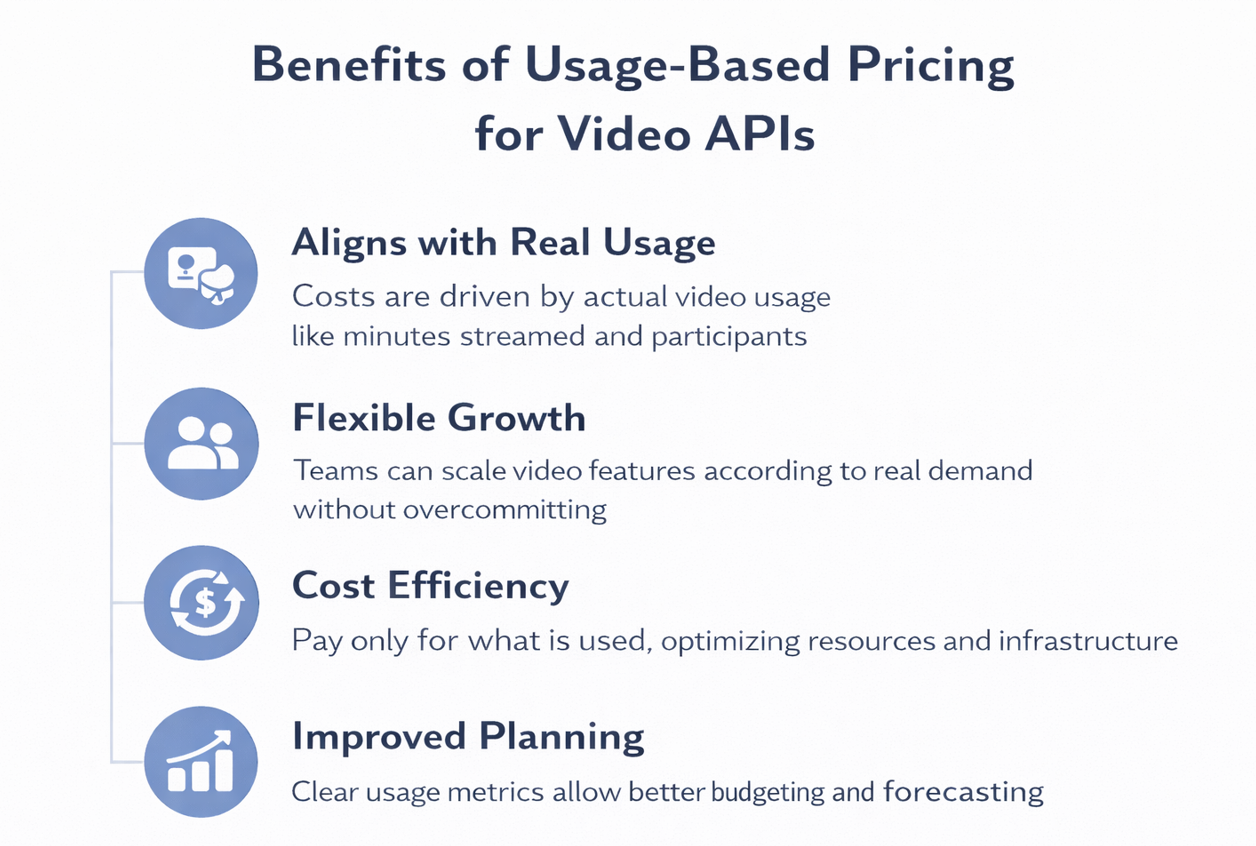
Benefits of Usage Based Pricing for Video APIs
Where Founders Start Getting Surprised
The first surprise usually comes from participant based billing.
Many founders assume they are paying per session but in reality, they are paying per participant per minute. And, this distinction is critical because a product designed around panel interviews, group onboarding, or collaborative sessions can see costs scale much faster than expected.
The second surprise is video quality.
High definition video is not free to deliver. Some platforms include it by default while others throttle quality unless you cross certain thresholds and, some charge explicitly for it. If your product promise depends on consistent video quality, especially in hiring or education, you cannot afford to skip this detail.
The third surprise appears when recordings enter the picture.
Recording feels like a checkbox feature until customers start relying on it. Storage, transcoding, and playback all add cost. These costs accumulate quietly over time, especially if recordings are retained for compliance or review.
The Real Risk Is Not High Cost - It's Unclear Cost
Founders can usually work with higher costs if they understand them. But, when those costs are not clearly described, the pricing model begins to feel random instead of directly ties to usage.
Teams loose visibility and forecasting the monthly bill becomes guesswork and that uncertainty eventually shows up in customer conversations. What should be a simple explanation turns into a back-and-forth discussion and defensive price choices.
This is where some usage based pricing models risk failing. Not because usage based pricing is flawed but because it is not clear enough how it works.
Platforms like Clan Meeting mitigate this risk by making usage explicit rather than implicit.
You can see every cost driver, consumption is tracked in real time, and payment is based on observable activities like minutes streamed and individuals connected. There are no hidden limits or surprises that come up at the end of the billing cycle.
With this level of insight, teams can work in new ways. Engineers can make smart trade-offs, the finance team can confidently make predictions, and the product teams can add video features without worrying that success may abruptly change margins.
In usage based pricing, transparency is not just an enhancement but the difference between a model that scales with trust and one that creates friction as soon as adoption grows.
How Founders Should Evaluate a Video Conferencing API Pricing Model
Before committing to any provider, founders should pressure test pricing against their actual product behaviour. This means stepping away from generic examples and doing the uncomfortable math -
- How long is the average session?
- How many participants typically join?
- What percentage of sessions are recorded?
- Where are users located geographically?
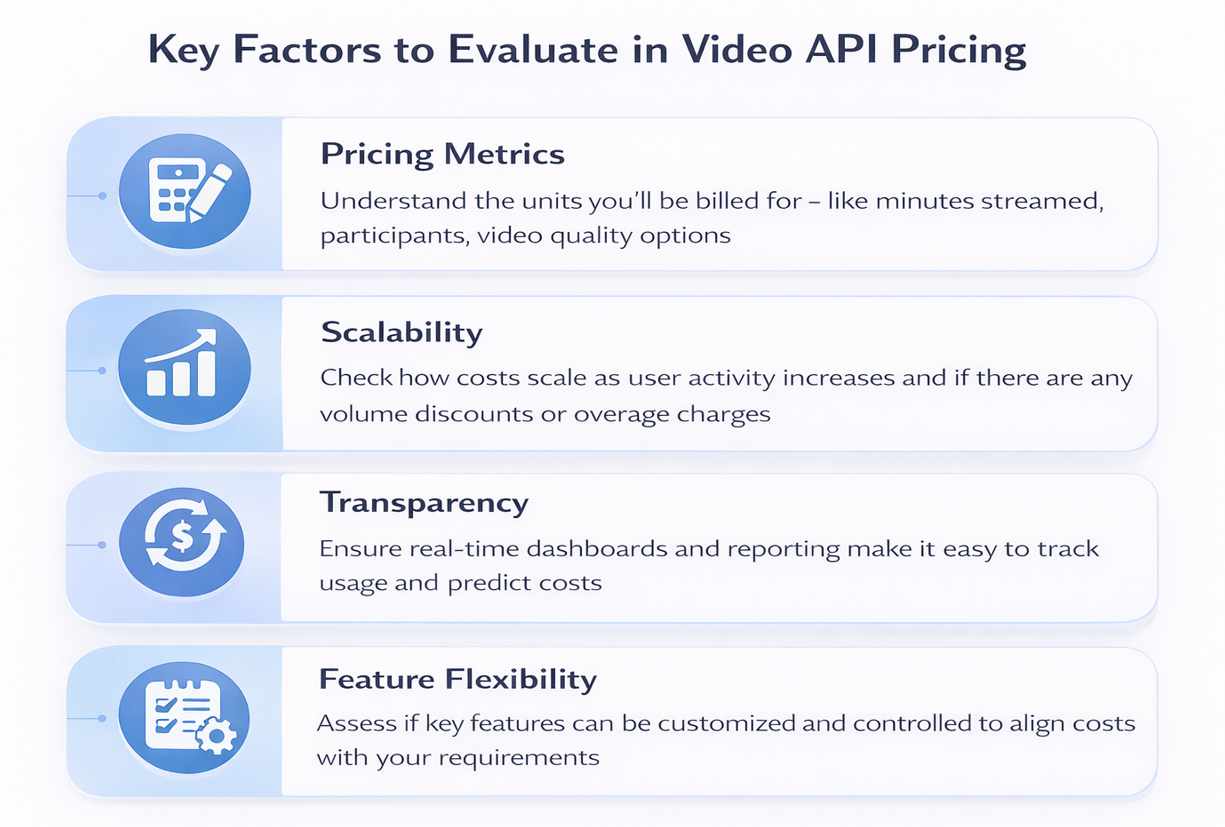
Key Factors to Evaluate in Video API Pricing
Once these questions are answered, the pricing model becomes clearer. The next step now is stress testing for scale by asking questions like - what happens when usage increases tenfold? Does the per unit cost remain stable or does it increase as you move into higher tiers?
Pricing models that punish growth are dangerous as they compress margins exactly when momentum builds.
Finally, founders should look closely at observability. If usage metrics are not visible, exportable and easy to explain, the pricing model will eventually become a liability.
Why Predictability Matters More Than Low Rates
Many founders focus on per minute pricing and miss the bigger picture.
A slightly higher per minute rate with stable economics is often better than a low headline price that escalates unpredictably as it enables confident decision making. It allows product teams to enable features without fear and allows finance teams to forecast without constant revisions.
This is especially important for platforms where video is not optional but core to the workflow.
Closing Thoughts
Usage based video conferencing API pricing is not a trend - it's is a reflection of how real time infrastructure works.
The mistake founders make is not choosing usage based pricing the mistake is choosing it without understanding how it behaves under real product conditions. The right model supports growth and the wrong one becomes visible in every margin discussion, roadmap debate, and pricing conversation.
Video is central to modern SaaS workflows to treat its economics casually. If you understand how usage based pricing works before scale forces the issue, you retain control and if you do not, the model controls you. That difference matters more than most founders realize at the start.
Frequently Asked Questions
1. What is usage based pricing for video conferencing APIs?
Usage based pricing means you pay based on actual consumption rather than a fixed subscription. Costs are typically calculated using metrics such as minutes streamed, number of participants, video quality, and features like recording or screen sharing. This pricing model reflects the real infrastructure costs of running live video in real time.
2. How is video conferencing API pricing different from normal SaaS pricing?
Traditional SaaS pricing is usually based on users, seats, or feature tiers and remains relatively fixed each month. Video conferencing API pricing is fundamentally different because it is tied to real time usage. Every live call consumes bandwidth, compute, and media processing resources, which makes consumption based pricing more accurate for video workloads.
3. Why do most video APIs use usage based pricing?
Most video APIs use usage based pricing because video usage is inherently unpredictable, especially in early stage products. A single customer running interviews, training sessions, or live events can significantly increase usage in a short period. Usage based pricing allows platforms to scale costs in line with real demand instead of relying on rigid plans that either overcharge or impose artificial limits.
4. Is usage based video conferencing API pricing predictable for founders?
Usage based pricing can be predictable if the platform offers clear pricing metrics and real time usage visibility. When founders understand exactly what is being measured and how usage scales with user behaviour, forecasting becomes manageable. Predictability breaks down only when pricing structures are opaque or usage data is delayed.
5. What should founders look for when evaluating a video conferencing API pricing model?
Founders should focus on a few core factors: what units are billed, how costs scale with participants and session length, whether usage is visible in real time, and if pricing remains stable at higher volumes. A good video conferencing API pricing model should align closely with how the product is monetized and avoid sudden jumps in per unit cost as usage grows.
6. Is usage based pricing better for products where video is a core workflow?
Yes, usage based pricing is generally better when video is central to the product experience, such as hiring, interviews, onboarding, training, or consultations. In these cases, usage closely tracks business activity, making it easier to align video costs with revenue. The key requirement is transparency so that increased adoption does not introduce unexpected margin pressure.